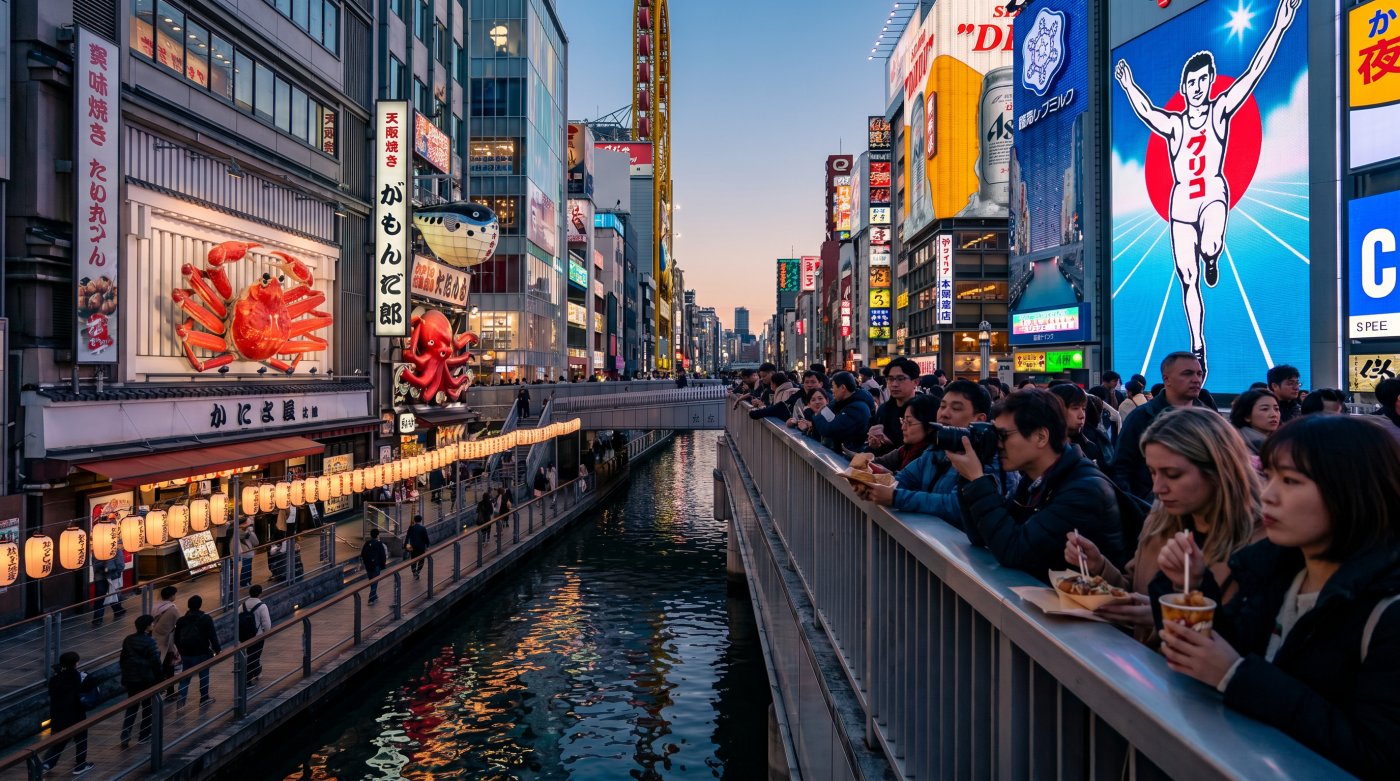
Osaka makes trip planning invigoratingly easy: neighborhoods like Namba, Umeda, and Dotonbori pack in food, nightlife, shopping, and transit links without endless commuting.
Spring and autumn bring the best weather, ICOCA cards simplify trains and subways, and budget options range from capsule hotels to lively guesthouses.
Visitors can balance takoyaki-fueled street wandering with Osaka Castle, Kaiyukan, and easy day trips to Kyoto or Nara, and the smartest tips, routes, and budget breakdowns come next.
Before moving on, we’d recommend you to first read our guide on things to know before traveling to Osaka.
Key Highlights
- Visit in spring or autumn for the best weather, though winter offers fewer crowds and summer is hot and humid.
- Stay in Namba or Shinsaibashi for nightlife, Umeda for transport convenience, or Shinsekai for budget-friendly retro charm.
- Use Osaka Metro and an ICOCA card to navigate easily from Kansai Airport and around the city.
- Prioritize Dotonbori, Osaka Castle, Shinsekai, Kaiyukan, and Universal Studios Japan for a balanced Osaka itinerary.
- Eat takoyaki, okonomiyaki, and kushikatsu at Dotonbori or Kuromon Ichiba to experience Osaka’s food culture.
Why Osaka Belongs at the Top of Every Japan Travel List
Although Tokyo often grabs the spotlight, Osaka earns its place at the top of any Japan travel list by being wonderfully easy to love: it is lively, welcoming, food-obsessed, and packed with personality at every turn.
In Osaka, Japan, the rhythm feels looser, brighter, less rule-bound, which makes it ideal for travelers craving spontaneity and room to roam.
A first-time visitor to Osaka quickly notices how simple it is to immerse oneself.
The best Osaka attractions sit close together, neighborhoods flow naturally, and many things to do in Osaka reward curiosity over rigid planning.
One can wander from neon canals to retro arcades, snack without ceremony, and still feel completely at ease.
That freedom is exactly why so many travelers visit Osaka early, then start plotting a return before the train even leaves.
For travelers seeking a taste of the city’s global dining scene, neighborhoods like Umeda and Horie offer some of Osaka’s best international restaurants.
What Is Osaka Japan and What Makes It So Worth Visiting
Osaka is Japan’s spirited merchant city, a major hub in the Kansai region where first-time visitors quickly notice its easy transit, lively neighborhoods, and more relaxed, talkative atmosphere.
It is especially famous for bold street food like takoyaki and okonomiyaki, but its appeal also comes from its comedy, nightlife, and down-to-earth personality—less polished than Tokyo, perhaps, yet wonderfully vivid.
For anyone planning a first visit, these essential facts and signature traits explain why Osaka leaves such a strong impression.
A great way to experience the city is through Dotonbori River Cruise, which offers a lively view of Osaka’s most famous entertainment district.
Key Facts About Osaka Every First-Time Visitor Should Know
Why does this city win over so many first-time visitors so quickly?
Osaka rewards independence: it is compact for a major metropolis, practical to navigate, and wonderfully connected to Kansai’s beaches, mountains, and neighboring cities.
For Osaka Japan travel, that means more spontaneity, less friction, and room to roam without rigid planning.
Several essentials shape a smoother first trip.
The best time to visit Osaka is typically spring or autumn, when temperatures stay comfortable and walking feels easy.
Visitors often ask, is Osaka safe; by big-city standards, yes, it is especially safe and straightforward.
Getting around Osaka is simple thanks to clear rail and subway networks, prepaid IC cards, and station signs in English.
Among useful Osaka travel tips, staying near a major station saves time, energy, and unnecessary backtracking daily.
Osaka Metro’s station codes and color-coded signs make it even easier to navigate the city without getting lost.
What Osaka Is Famous For: Food, Culture, and Personality
Because the city wears its character so openly, first-time visitors quickly understand what Osaka Japan is really about: bold street food, easygoing humor, and a proudly unpolished energy that feels invigoratingly human.
An Osaka trip often revolves around eating first, planning later, and that is exactly the charm.
Any reliable Osaka food guide points straight to takoyaki, okonomiyaki, kushikatsu, and the glorious chaos of street food in Osaka, especially around Dotonbori.
Beyond meals, Osaka is known for merchants’ wit, neon nights, comedy, baseball passion, and a fiercely local spirit that refuses to act stiff.
For travelers chasing freedom, the Osaka must-see list includes castle grounds, Shinsekai wanderings, and riverfront evenings.
Among the most fun things to do in Osaka, simply roaming and snacking may be the most revealing experience of all.
The city’s value for money food culture makes it easy to sample everything from budget snacks to memorable splurges without losing the sense of fun.
How To Get to Osaka: Flights, Trains, and Entry Into the City
Getting to Osaka is invigoratingly straightforward, whether travelers land at Kansai International Airport or arrive by shinkansen from Tokyo or Hiroshima.
From KIX, fast trains, airport buses, and convenient transfers make the trip into the city smooth and efficient, while the bullet train brings passengers into Osaka with trademark speed and polish.
A quick look at these main routes shows just how easy the city makes a first arrival.
If you’re heading to Minami, the Nankai Rapi:t is the fastest rail option from KIX.
Flying Into Kansai International Airport and Getting Into Osaka
Touching down at Kansai International Airport, set dramatically on an artificial island in Osaka Bay, travelers are only about 45 to 70 minutes from central Osaka depending on the route they choose.
The fastest options are the JR Haruka or Nankai Rapi:t, while airport limousines suit heavier bags and late arrivals.
For freedom and flexibility, IC cards make transfers painless.
Once in the city, the Osaka metro facilitates easy movement between sights, useful when deciding the best area to stay in Osaka or comparing the best neighborhoods to stay in Osaka.
Anyone wondering if Osaka is walkable should know many districts are, though trains save time.
For visitors doing Osaka on a budget, regular airport express trains cost less and still deliver a smooth, scenic first glimpse of the city.
The ICOCA card is also a convenient prepaid option for using Osaka Metro, JR lines, and many buses, shops, and vending machines.
Arriving by Shinkansen: Taking the Bullet Train to Osaka From Tokyo or Hiroshima
For travelers arriving overland rather than through Kansai International Airport, the shinkansen is the sleek, stress-free way into Osaka, whisking passengers from Tokyo to Shin-Osaka in about 2.5 to 3 hours and from Hiroshima in roughly 1.5 hours.
It delivers speed, legroom, and that liberating glide past cities, rivers, and green hills.
From Shin-Osaka, JR lines and the Midosuji Subway make onward travel simple, whether heading to Namba, Umeda, or a hotel near Osaka Castle.
Reserved seats add comfort, while rail passes can reduce Osaka trip cost for travelers comparing how much to budget for Osaka in any Osaka travel guide.
If your itinerary includes multiple attractions, the Osaka Amazing Pass can be a smart way to save on both transit and admission.
It also works brilliantly for flexible itineraries, especially when planning day trips from Osaka or classic Osaka day trips—because nobody comes to Japan for boring transfers.
Best Time To Visit Osaka: A Season-by-Season Breakdown
Osaka changes dramatically with the seasons, and each part of the year brings its own perks, quirks, and weather patterns.
Spring usually steals the spotlight with cherry blossoms, comfortable temperatures, and bigger crowds, while summer, autumn, and winter each offer a distinctly different version of the city.
A season-by-season look helps clarify when Osaka feels festive, manageable, budget-friendly, or simply at its most enjoyable.
October and November are especially appealing for cooler air, autumn foliage, and fewer crowds. For more information, read our guide about the best time to visit Osaka.
Spring in Osaka: Cherry Blossoms, Crowds, and Perfect Temperatures
When spring arrives, the city hits a sweet spot: daytime temperatures usually hover around 15–20°C (59–68°F), cherry trees burst into soft pink bloom, and parks like Osaka Castle Park, Kema Sakuranomiya Park, and Expo ’70 Commemorative Park become instant picnic magnets.
It’s the season when Osaka feels loose, lively, and easy to roam on foot.
Crowds do swell during peak blossom weeks, especially on weekends, so early mornings buy more breathing room and cleaner photo ops.
Travelers chasing flexibility often lock in budget accommodation in Osaka well ahead, then use spring’s mild weather to wander river paths, snack under sakura, and hop between neighborhoods without feeling rushed.
Light layers work best, pollen can be sneaky, and spontaneous hanami plans usually beat over-scheduling—because this city shines brightest when there’s room to drift.
For a quieter seasonal escape, Minoo Park offers forested trails and a famous waterfall just beyond the city.
Summer, Autumn, and Winter in Osaka: What Each Season Actually Delivers
Although spring gets most of the postcard glory, the rest of the year gives Osaka three very different personalities—summer arrives hot, humid, and festival-heavy; autumn turns crisp and colorful; winter feels leaner, brighter, and surprisingly comfortable for city exploring.
Summer means Tenjin Matsuri, rooftop beer gardens, and late nights by the river.
Autumn brings temple gardens, fiery leaves at Minoh and Osaka Castle Park, and easier wandering.
Winter offers illuminations, bargain hotel rates, and fewer queues at major sights.
Each season rewards travelers who want flexibility, not just blossom-chasing.
Summer can feel like walking through soup, but the city compensates with fireworks, food stalls, and electric nightlife.
Autumn is arguably Osaka’s easiest season, invigorating enough for long walks yet lively with color.
Winter rarely bites too hard, making street-food runs and museum hopping feel refreshingly liberating.
For a lively urban detour, Dotonbori Canal delivers neon lights, street food, and some of Osaka’s most photographed night scenes.
Where To Stay in Osaka: Best Neighborhoods for Every Type of Traveler
Choosing where to stay in Osaka can shape the entire trip, and the city makes it easy to match a neighborhood to a traveler’s style.
Namba and Shinsaibashi put visitors in the middle of the neon, food, and late-night energy, while Umeda stands out for smooth transport links, department stores, and all-around convenience.
For travelers watching costs, Osaka also offers plenty of budget-friendly hostels, capsule hotels, and guesthouses that keep the stay simple, social, and smart.
Namba and Shinsaibashi: Staying in the Heart of the Action
For travelers who want Osaka at full volume, Namba and Shinsaibashi place them right in the city’s brightest, busiest core.
This is the district for late nights, neon views, impromptu shopping, and easy wandering; everything feels open-ended, as if the city refuses to suggest bedtime.
- Dotonbori delivers flashing signs, canal walks, and endless street food.
- Shinsaibashi-suji keeps shoppers roaming beneath a long covered arcade.
- Amerikamura adds youthful style, vintage finds, and creative energy.
- Namba stations make day trips and airport access remarkably straightforward.
Hotels range from sleek high-rises to compact business stays and stylish hostels, so travelers can choose comfort, character, or budget freedom.
Noise and crowds come with the territory, but for people chasing spontaneity, flavor, and a little glorious chaos, this area rarely disappoints, ever.
Umeda: The Best Area To Stay in Osaka for Convenience and Shopping
When ease, transit, and polished city energy matter most, Umeda rises to the top without much debate.
This is Osaka at its sleekest: giant stations, department stores, rooftop views, and smooth connections that let travelers roam freely without wasting time.
JR Osaka Station and Umeda’s linked rail lines make day trips almost absurdly easy.
The neighborhood suits visitors who want independence with comfort.
By day, they can engage with Grand Front Osaka, Hankyu, or Daimaru, then surface for skyline panoramas at Umeda Sky Building.
Budget Accommodation in Osaka: Hostels, Capsule Hotels, and Guesthouses
Plenty of Osaka’s best-value stays cluster in neighborhoods that keep both train fares and walking distances pleasantly low, which is exactly the kind of small victory budget travelers appreciate.
Around Namba, Shinsekai, and Tennoji, hostels, capsule hotels, and guesthouses give visitors room to roam without chaining them to expensive commutes.
Freedom matters here!
- Hostels near Namba suit social travelers who want nightlife, cheap eats, and easy subway access.
- Capsule hotels in Umeda and Shinsaibashi offer sleek, efficient beds for late-night wanderers.
- Guesthouses around Tennoji feel calmer, often with kitchens and friendly local tips.
- Shinsekai stays trade polish for personality, with retro streets and budget prices.
Most places stay clean, compact, and practical.
Travelers who pack light, book early, and stay near a station usually gain access to Osaka at its most spontaneous.
Top Things To Do in Osaka for First-Timers and Repeat Visitors
Osaka offers a lineup that works brilliantly for both first-timers checking off the icons and repeat visitors looking for something fresh.
The city’s essential sights, from headline landmarks to neon-lit streets and legendary food hubs, set the stage, while quieter corners and lesser-known experiences reveal a more textured, memorable side of the city.
What follows highlights the must-sees that earn their reputation and the offbeat picks that prove Osaka still has surprises left!
Osaka Must-See Attractions You Simply Cannot Skip
Any shortlist of Osaka highlights usually begins with Dotonbori, where flashing neon, cheerful chaos, and irresistible street food create the city’s most famous first impression.
It then turns to Osaka Castle, a polished blend of history, spacious gardens, and wide skyline views, before shifting to Shinsekai and Tsutenkaku Tower, where old-school Osaka still crackles with charm and a slightly mischievous spirit.
Together, these three stops give visitors a vivid, well-rounded look at Osaka at its boldest, tastiest, and most atmospheric.
Dotonbori: Neon, Noise, and the Best Street Food in Japan
Although the canal itself is only a narrow ribbon through Minami, Dotonbori delivers Osaka at full volume—towering neon, jostling crowds, boat lights skimming the water, and the iconic Glico Running Man flashing above it all.
- Takoyaki
- Okonomiyaki
- Kushikatsu
- Late-night wander
Here, travelers graze freely, following smoke, sauce, and instinct through Japan’s most exuberant food corridor after dark.
Osaka Castle: History, Gardens, and Skyline Views in One Stop
Few landmarks pull together so much of the city’s identity in one easy visit as Osaka Castle—samurai-era drama, wide green parkland, and panoramic views all wrapped into a single stop.
Inside, exhibits trace warlords and rebuilding.
Outside, moats, plum groves, and broad lawns invite wandering without hurry.
The top-floor observatory rewards that freedom with crisp city vistas and a satisfying sense of scale.
Shinsekai and Tsutenkaku Tower: Old Osaka at Its Most Atmospheric
Once the route turns south into Shinsekai, Osaka reveals one of its most colorful, time-warped corners, where retro signboards glow, kushikatsu shops sizzle, and the whole neighborhood feels cheerfully stuck between nostalgia and neon.
- Tsutenkaku views
- Kushikatsu feasts
- Janjan Yokocho strolls
- Billiken luck
It rewards wandering, late-night snacking, and a little glorious aimlessness.
Here, old Osaka still struts, unapologetically free.
Fun Things To Do in Osaka Beyond the Obvious Tourist Trail
Beyond Osaka’s headline sights, the city opens up in places like Nakazakicho and Hozenji Yokocho, where retro cafés, narrow lantern-lit lanes, and everyday neighborhood energy show a more intimate side of local life.
These are the kinds of areas locals return to for slow strolls, good food, and atmosphere that feels wonderfully unpolished—in the best way.
For a completely different rhythm, Universal Studios Japan and Osaka Aquarium make an easy full-day adventure, pairing blockbuster thrills with mesmerizing marine displays.
Nakazakicho, Hozenji Yokocho, and the Neighborhoods Locals Love
While Dotonbori and Osaka Castle grab the spotlight, the neighborhoods that locals return to again and again reveal the city’s more intimate, character-packed side.
- Nakazakicho: retro cafes
- Hozenji Yokocho: lantern-lit charm
- Tenma: lively bars, easy wandering
- Shinsekai backstreets: old-school energy
These districts reward unhurried roaming, spontaneous stops, and the kind of free-form exploring that makes Osaka feel personal, not performed.
Universal Studios Japan and Osaka Aquarium for a Full-Day Adventure
For travelers ready to swap alleyway charm for all-out spectacle, Universal Studios Japan and Osaka Aquarium Kaiyukan make an easy, high-energy pairing for a full day around Osaka Bay.
One delivers cinematic thrills and crowd-pleasing rides; the other slows the pulse with whale sharks, glowing jellyfish, and sweeping Pacific habitats.
Ferries, trains, and flexible ticketing keep the itinerary breezy, spontaneous, and gloriously untethered all day.
Osaka Food Guide: What To Eat, Where To Go, and How To Order
Osaka’s food scene quickly takes center stage, with street staples like takoyaki, okonomiyaki, and kushikatsu setting the tone for a city that treats eating like a serious pleasure.
The discussion naturally turns to the places that show this best—bustling markets, neon-lit food streets, and local favorites where the grills sizzle, the sauces shine, and the crowds rarely steer anyone wrong.
Just as important, a few simple ordering tips help make the experience smoother, faster, and far more fun.
Street Food in Osaka: Takoyaki, Okonomiyaki, Kushikatsu, and More
If there is one place in Japan where street food feels like part of the city’s personality, it is Osaka.
Here, eating on a whim feels gloriously right, and the classics deliver big flavor without ceremony.
- Takoyaki: crisp outside, molten inside, topped with sauce, mayo, and dancing bonito.
- Okonomiyaki: a savory pancake packed with cabbage, batter, and whichever fillings call out.
- Kushikatsu: skewered, breaded, fried, and best enjoyed hot, crunchy, and unapologetically messy.
- More to try: yakisoba, ikayaki, and horumon for deeper dives into Osaka’s bold palate.
A few ordering basics help: point confidently, watch the grill, and expect fast service. Cash
often keeps things simple.
The reward is freedom on a plate—quick bites, rich aromas, and zero pressure to linger politely.
Best Markets and Food Streets for an Authentic Osaka Eating Experience
For an authentic Osaka eating experience, two names quickly rise to the top: Kuromon Ichiba Market and Dotonbori Restaurant Row.
Kuromon Ichiba is known for fresh seafood, sizzling skewers, and bold flavors that hit fast and linger, while Dotonbori offers a sit-down scene packed with reliable local favorites and bright canal-side energy.
Together, they sketch a clear picture of Osaka’s food culture—lively, hearty, and absolutely serious about good eating.
Kuromon Ichiba Market: Fresh Seafood, Skewers, and Serious Flavors
Plunge into Kuromon Ichiba Market, and the mood shifts instantly, sizzling skewers, briny seafood, and the sweet scent of grilled scallops pulling crowds down this long, lively arcade near Nippombashi.
- uni
- tuna
- wagyu skewers
- melon
This is Osaka set free: fast, flavorful, gloriously untidy.
Visitors roam freely, sampling one bite at a time, cash ready, appetite wide open, chasing whatever looks hottest, freshest, or wildly irresistible.
Dotonbori Restaurant Row: Where To Eat When You Want To Sit Down
Where does a hungry traveler go in Dotonbori when the feet are tired and the meal needs more than a quick skewer?
Restaurant Row answers with ramen counters, okonomiyaki grills, kushikatsu taverns, and upstairs izakaya where one can linger, order boldly, and escape the neon rush.
The smart move is ducking into side streets near Ebisubashi for shorter lines, better seats, and fuller flavor.
Getting Around Osaka: Transportation Tips That Save Time and Money
Getting around Osaka is invigoratingly straightforward: the Osaka Metro and major train lines connect the city’s key districts with impressive speed and reliability.
Smart travelers often save both time and yen by using IC cards for easy tap-and-go access, while day passes and the Osaka Amazing Pass can add serious value, especially on sightseeing-heavy days.
Just as appealing, several popular areas, including Namba, Dotonbori, and Shinsaibashi, are highly walkable, making it easy to trade crowded platforms for a pleasant stroll.
Osaka Metro and Train Lines: How the Public Transport Network Works
Although Osaka’s transit map can look like a bowl of neon spaghetti at first glance, the system is wonderfully practical once its basic logic clicks.
Osaka Metro handles central neighborhoods, while JR and private railways stretch outward, giving travelers room to roam fast and freely.
- Metro lines are color coded and numbered, so transfers feel far less chaotic.
- The Midosuji Line is the north-south backbone, linking Shin-Osaka, Umeda, Namba, and Tennoji.
- Loop-oriented JR lines help with cross-city hops, especially around Osaka Station and Tennoji.
- Private railways connect easy escapes to Kobe, Kyoto, Nara, and the bay area.
Stations are well signed in English, platforms are orderly, and trains run with almost suspicious punctuality.
Once the main hubs are recognized, the city opens up beautifully, almost like a backstage pass.
IC Cards, Day Passes, and the Osaka Amazing Pass Explained
Once the rail map starts making sense, fare choices become the next smart move, and Osaka gives travelers several excellent ones.
IC cards such as ICOCA and Suica are the easiest option: tap in, tap out, reload quickly, and glide between trains, subways, and buses without fumbling for tickets like a confused arcade loser.
Day passes work best for travelers planning a packed schedule.
The Osaka Metro pass can cut costs on heavy transit days, especially when hopping between major districts.
The Osaka Amazing Pass goes further, bundling unlimited rides with entry to popular attractions, which can deliver serious value if used strategically.
The smart move is simple: choose an IC card for flexibility, a day pass for nonstop city-hopping, or the Amazing Pass for ambitious sightseeing freedom.
It keeps the budget happier too.
Is Osaka Walkable? Which Areas You Can Explore Entirely on Foot
How walkable is Osaka?
Quite walkable in the right districts, especially for travelers who like wandering without rigid schedules.
The city is huge, yet several neighborhoods unfold beautifully on foot, with arcades, river paths, and neon-splashed streets linking sights, food, and nightlife.
- Dotonbori to Shinsaibashi: easy, lively, packed with shops and snacks
- Namba to Nipponbashi: great for anime, electronics, and street-food detours
- Umeda around Osaka Station: dense, polished, and surprisingly manageable
- Osaka Castle Park: spacious, scenic, and best explored slowly
A visitor can freely roam these areas for hours, ducking into cafes, shrines, and side streets whenever curiosity wins.
That said, Osaka is not a one-neighborhood city; trains bridge the bigger gaps fast.
Walking works brilliantly here, but smart pairing with transit keeps feet happy too.
Day Trips From Osaka: The Best Destinations Within Easy Reach
Osaka makes an excellent base for day trips, with Kyoto and Nara standing out as the most popular choices thanks to their famous temples, historic streets, and easy train access.
For travelers willing to spend a little more time in transit, Kobe, Himeji, and even Hiroshima open up a wider range of experiences, from waterfront dining and elegant castles to powerful historical landmarks.
The following options show just how much can fit into a single day beyond the city limits.
Kyoto and Nara: The Two Most Popular Osaka Day Trips for Good Reason
While plenty of worthwhile escapes sit within easy reach, Kyoto and Nara keep earning top billing because they deliver two completely different moods in a single, easy day trip conversation.
Kyoto gives travelers room to roam through temple-lined lanes, bamboo groves, old teahouse districts, and polished gardens that feel cinematic without trying too hard.
Nara moves slower, inviting easy wandering between monumental shrines, broad parkland, and famous deer that act like they own the place—because, honestly, they do.
- Choose Kyoto for layered history and neighborhood-hopping freedom
- Choose Nara for open space, big icons, and a gentler pace
- Reach both quickly by train, making spontaneous plans realistic
- Start early to dodge crowds and reclaim the day
Together, they offer flexibility, contrast, and maximum cultural payoff with very little planning stress.
Kobe, Himeji, and Hiroshima: Longer Day Trips Worth the Extra Travel Time
If the schedule allows for a slightly longer train ride, Kobe, Himeji, and even Hiroshima open up a bigger, bolder version of the Kansai day-trip map.
For travelers who like room to roam, these cities reward the extra mileage with distinct moods, standout sights, and fewer reasons to rush.
Kobe mixes sea breeze, mountain views, and stylish streets around Kitano, Harborland, and Chinatown, with famous beef as a worthy splurge.
Himeji is the classic castle escape, where Japan’s finest feudal fortress rises in brilliant white above spacious grounds made for wandering.
Hiroshima, while ambitious, becomes surprisingly doable by shinkansen, offering the Peace Memorial Park, moving museums, and easy side access to Miyajima’s floating torii.
It is a long day, yes, but sometimes freedom looks exactly like boarding one more train. Day trip to Himeji from Osaka also a very good choice for every traveler.
Osaka Travel Tips: Money, Safety, Etiquette, and Staying Connected
Osaka is widely regarded as a safe, traveler-friendly city, including for solo visitors, but a few practical basics can make the trip smoother from the first train ride to the last late-night snack.
This section covers the essentials: when to carry cash, how yen and the local no-tipping custom work, and which option, SIM card or pocket Wi-Fi, keeps travelers reliably online while exploring the city.
With these simple tips in place, moving through Osaka tends to feel easy, efficient, and pleasantly stress-free.
Is Osaka Safe for Tourists and Solo Travelers?
Generally speaking, the city is very safe for tourists and solo travelers, even late into the evening around busy hubs like Namba, Umeda, and Shinsaibashi, where bright signs flash, trains hum, and crowds keep the streets lively.
Osaka feels easygoing, energetic, and invigoratingly low-stress for independent wandering.
- Stay aware in nightlife pockets like Dotonbori.
- Keep bags zipped on packed trains.
- Use women-only cars during rush hour.
- Follow station signs; they are excellent.
Police boxes, called koban, are scattered across central districts and can help with directions or minor problems.
Common sense still matters, of course: avoid drunken arguments, watch belongings in crowds, and trust instincts if a street feels off.
For most visitors, though, Osaka offers the sweet spot, freedom to roam, snack, explore, and night-stroll with confidence.
Cash, Currency, and Tipping Culture in Osaka Japan
With safety feeling pleasantly straightforward, money matters in Osaka are just as manageable once a few local habits click into place.
Japan uses the yen, and while cards are increasingly accepted in hotels, chain stores, and major attractions, cash still keeps plans flexible, especially in small eateries, market stalls, temples, and older bars tucked into neon-lit alleys.
ATMs at convenience stores such as 7-Eleven and Lawson are usually the easiest bet for international cards.
It is smart to carry a modest stash of bills and coins; fare machines, lockers, and quick snacks love exact change.
Tipping, meanwhile, is not part of the culture.
Service is already built in, polished and professional, so leaving extra can create confusion rather than gratitude.
In short: pay smoothly, pocket the coins, and roam freely.
SIM Cards, Pocket Wi-Fi, and Staying Online During Your Osaka Trip
Because reliable data makes city navigation wildly easier, most travelers find it worth sorting out connectivity as soon as they land.
Osaka rewards spontaneity, and staying online means instant train routes, restaurant finds, and flexible day plans without hunting for flaky public Wi-Fi.
- SIM cards suit solo travelers wanting simple, affordable data.
- eSIMs work brilliantly for compatible phones and fast setup.
- Pocket Wi-Fi is ideal for groups sharing multiple devices.
- Airport counters at Kansai International make pickup painless.
Vending-machine convenience this is not, but the process is usually quick.
Major providers offer strong coverage across Osaka, from neon Dotonbori to quieter Sumiyoshi streets.
Travelers should compare daily data limits, battery life, and return rules before committing.
With dependable internet sorted, they can roam more freely, pivot faster, and enjoy the city with fewer logistical headaches.
Osaka Trip Cost: How Much To Budget for Your Visit
Budgeting for Osaka usually starts with three core categories: where one sleeps, what one eats, and how much one plans to see each day.
Costs can range from lean and practical to comfortably flexible, and the city makes both styles surprisingly easy to manage.
With a smart mix of affordable stays, excellent cheap eats, and low-cost attractions, even a budget-minded visit can still feel packed with the good stuff.
Daily Budget Breakdown for Osaka: Accommodation, Food, and Activities
How much should a day in Osaka really cost?
For most travelers, a flexible daily range lands between ¥9,000 and ¥22,000, depending on comfort, appetite, and pace.
Osaka rewards independence: one can sleep simply, feast brilliantly, and still leave room for spontaneous fun.
- Accommodation: hostels or budget hotels usually run ¥3,500–¥8,000.
- Food: casual meals, coffee, and snacks often total ¥2,500–¥5,000.
- Activities: museums, observation decks, and entertainment average ¥1,500–¥5,000.
- Transport and extras: local trains, drinks, and small purchases add ¥1,500–¥4,000.
That means a no-frills day stays lean, while a more carefree day climbs comfortably higher.
Either way, Osaka makes spending feel joyful, not restrictive; the city practically nudges visitors outside, toward sizzling streets, bright arcades, and another irresistible bite.
How To Visit Osaka on a Budget Without Missing Anything Good
While Osaka can tempt visitors into spending wildly, the city is surprisingly easy to enjoy on a modest budget without sacrificing the good stuff.
Smart travelers stay near subway lines in business hotels or hostels, grab day passes, and let efficient transit reveal neighborhoods without expensive taxis or rigid tours.
They eat brilliantly for less by chasing lunch specials, standing sushi counters, ramen shops, and basement food halls.
Kuromon Market is fun, but local shotengai often serve better value and fewer selfie sticks.
Many highlights cost little or nothing: Osaka Castle Park, Dotonbori at night, Shinsekai, Sumiyoshi Taisha, and river walks in Nakanoshima.
Booking major attractions online, traveling midweek, and mixing iconic sights with free street life keeps the trip loose, vivid, and satisfyingly cheap.
Most Asked Questions
Do I Need Travel Insurance for an Osaka Trip?
Travel insurance is not legally required for an Osaka trip, but it is strongly recommended.
A traveler gains freedom, not limits, by carrying coverage for medical care, cancellations, lost baggage, and unexpected disruptions.
Japan is safe and efficient, yet accidents and illness can still strike without warning.
Smart visitors compare policies before departure, especially if carrying expensive gear or planning food adventures, nightlife, or fast-paced day trips around Kansai.
What Apps Should I Download Before Visiting Osaka?
Like a cyclist grabbing a city map before flying downhill, a visitor should download Google Maps, Japan Travel by NAVITIME, and Google Translate first.
Suica or ICOCA apps streamline trains, while Uber and DiDi help late at night.
Klook is handy for booking Universal Studios Japan or Osaka Aquarium tickets.
In 2023, Japan welcomed over 25 million visitors, so reservation apps can save precious time and spare a few station meltdowns.
Are There Luggage Storage Options Around Osaka?
Yes—Osaka offers plentiful luggage storage, giving travelers easy freedom to roam.
Coin lockers sit in major stations like Osaka, Namba, and Shin-Osaka, while manned counters and app-bookable services appear near Umeda, Dotonbori, and Kansai Airport.
Sizes vary, so oversized suitcases may need staffed storage.
Availability fills quickly during busy hours; consequently, early use helps.
Hotels also often hold bags before check-in or after checkout, a small but glorious mercy.
Can I Visit Osaka Comfortably With Small Children?
Yes—Osaka suits small children surprisingly well.
Like a kite catching steady harbor wind, one family breezed through Kaiyukan, then napped on the Midosuji Line without fuss.
Wide sidewalks in Namba Parks, plentiful elevators in major stations, kid-friendly menus, and spotless department-store nursing rooms make roaming feel easy.
Tennoji Zoo, Kids Plaza Osaka, and shaded castle grounds give restless little legs room to run, snack, and reset happily.
How Accessible Is Osaka for Travelers With Disabilities?
Osaka is fairly accessible for travelers with disabilities, and it lets visitors move with impressive freedom. Major stations
like Umeda and Namba usually have elevators, tactile paving, and accessible toilets, while newer hotels and malls handle ramps and wide entrances well.
Some older streets, shrines, and smaller restaurants remain tricky, though—Japan loves a surprise staircase! Planning ahead
, using station maps, and booking accessible accommodation makes exploring Osaka much smoother and more enjoyable.
Wrapping Up
Osaka rewards travelers who plan smart and stay curious.
From neon-lit streets and sizzling street food to efficient trains and easy day trips, the city unfolds like a well-packed bento box, full of variety and surprise.
With the right timing, neighborhood, and budget, a smooth, memorable visit comes together fast.
For anyone building a Japan itinerary, Osaka does not just fill a gap, it brings the whole journey to life with flavor, energy, and unforgettable character.